Showing posts with label Boston. Show all posts

Monday, June 6, 2016

Day #2 in Boston, Part 2

Tremont Street's first place of interest was King's Chapel and King's Chapel Burying Grounds.  


The Chapel is Unitarian in theology, Anglican [Episcopalian] in worship, and Congregational in governance.  The granite building was built in 1754 and is often referred to as the "Stone Chapel". The congregation was founded in 1686 as the first Anglican Church in Colonial New England, and later in 1785 became the first Unitarian Church in America.  I was intrigued that the church offers Evensong - something I only associated with churches in England.   The interior was beautiful.


The chapel's unique seating is original "box pews" where families paid a yearly rental fee to decorate their box of pews to their own liking.  No worries about someone taking their seat if they rented it and it belonged exclusively to them! ;-)  Box pews were new to me.  Have you heard of them? 

Attendees of King's Chapel include George Washington, Paul Revere, Benjamin Franklin, John Hancock, Oliver Wendell Holmes and author, Louisa May Alcott.  Below is a side box section underneath the upper balcony.


Founded in 1630, the cemetery is the oldest cemetery in Boston, and is on the Freedom Trail route. It is situated next to King's Chapel. It was Boston's only burial site for 30 years. Among those buried there are John Winthrop [first governor of Massachusetts], and Mary Chilton, the first woman to step off the Mayflower.


Years of weathering has made some of the tombstones almost unreadable.


~ John Winthrop's Grave ~


Down from King's Chapel and cemetery [on the opposite side of Tremont] is Granary Burial Ground [also part of Freedom Trail].  It was established in 1660, and is the city's third oldest cemetery.  Three signers of the Declaration of Independence are buried there - John Hancock, Samuel Adams, and Robert Treat Paine, as well as eight governors, Paul Revere, five victims of the Boston Massacre, and several of Boston's Revolutionary War Patriots.


~ The arch is the gateway to the cemetery. ~


Somewhere between 5,000 - 8,000 people are estimated to be buried in the small cemetery under 2,345 grave markers [up to 20 bodies beneath each tombstone].  The granite obelisk in the center of the graveyard marks the graves of Benjamin Franklin's parents.


The cemetery was bustling with tourists and groups of school children.


Next to the cemetery is Park Street Congregational Church, founded in 1804 and built in 1809.  The church's 217 foot steeple was once the first landmark travelers saw when approaching Boston, and is still a visible landmark from several Boston neighborhoods.


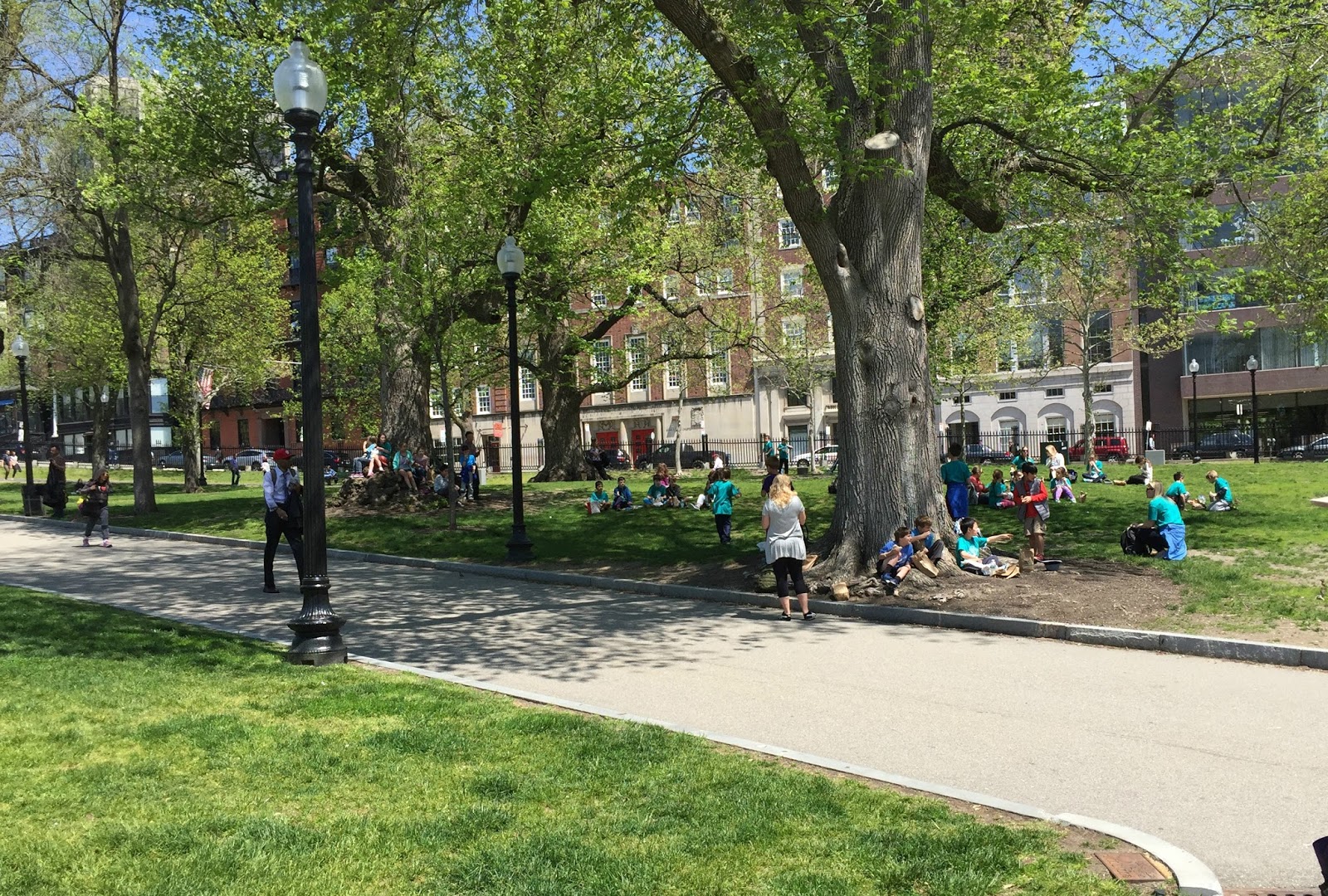
Directly across from the church on the corner of Park and Tremont streets begins the the Boston Common. [It is also the starting point of the Freedom Trail.]  Downtown Boston's public central park dates back to 1634, and is the oldest city park in the United States. The park's current landscape configuration was downsized to 24 acres [from 50 acres] in 1860, and anchors the 'Emerald Necklace', a system of connected parks and parkways that winds through many Boston neighborhoods.  It was a beautiful day, and Bostonians were enjoying the park. It reminded me of the parks in London, England.


Boston has a subway system [America's first], and its history and a diagram was posted in Boston Common.


Included in Boston Common is Lafayette Mall where a bronze plaque honors the Frenchman, Marquis de Lafayette, a Revolutionary War Patriot.


Jerry and I cut through Boston Common to Beacon Street, our lunch destination - tomorrow's post.


Friday, June 3, 2016

Day #2 in Boston, Massachusetts

Day #2 began the same as day #1 with the trolley picking us up at our hotel at 7:15 a.m.  We rode to stop #5 and got off to tour the Old State House Museum at Washington and State Streets. Built in 1713, it is one of the oldest public buildings in the U.S., and the oldest surviving public building in Boston.  It was designated a National Historic Landmark in 1960.

On July 18, 1776 the Declaration of Independence was proclaimed from the balcony [which can be seen in the photo below].  The lion and unicorn - symbols of British royal power - are still mounted in the top left and right corners of the building's exterior. Later, Governor John Hancock used the building as the first Massachusetts State Capitol.


~ Boston Massacre sign affixed to the side of Old State House ~


~ Opposite End of Old State House ~


Interior of Old State House and one of the two chamber rooms on the second floor.


~ Chamber room at opposite end ~


Winding stair case in the middle separating the two chamber rooms.  The docent was relating historical facts and events associated with the building.


 ~ Artifacts in the building, including a tea caddy. ~


In the museum's first floor gift shop was the tea-themed T-shirt below.  Amazingly, I didn't buy it!


From Old State House Jerry and I walked up Court Street because I wanted to see the Giant Steaming Tea Kettle that hangs over Starbucks on the corner of Court and Tremont Street. Currently it's a heavy construction area, and would you believe a truck hit it the day before we arrived and knocked it down. I was so bummed I didn't get to see it!  Below is an Internet photo of the kettle. It was manufactured in 1873 as a symbol for the Oriental Tea Company, and holds 227 gallons of water.  


All I got to see was the sign that hangs a short distance from the kettle.  We were told the kettle will be repaired and rehung because it' a Boston landmark and tourist attraction.


Jerry and I walked up Tremont Street and viewed several more interesting sites which I'll tell you about in my next post.  


Thursday, June 2, 2016

Boston Tea Party Museum, Boston, MA

After we ate we went downstairs to the gift shop.  Unfortunately, the photo below is the only photo I took of the shop, but it had tea, china, linens, books, American Revolutionary War memorabilia, and so much more.  Because we flew to Boston, space for purchases was limited, but I made room for a tea towel, a spiced mug mat, a Sandy Lynam Clough book [Sharing a Cup of Friendship], and a tin of tea - Abigail's Blend.  


After the gift shop, our three-part museum tour began in a replica of the "Old South Meeting House" where we were transported back to Colonial Boston.  Each person was given a feather for their "mohawk disguise". [The keepsake was stamped "Boston Tea Party" December 16, 1773.] In the photo below the Meeting House was just beginning to fill with people.


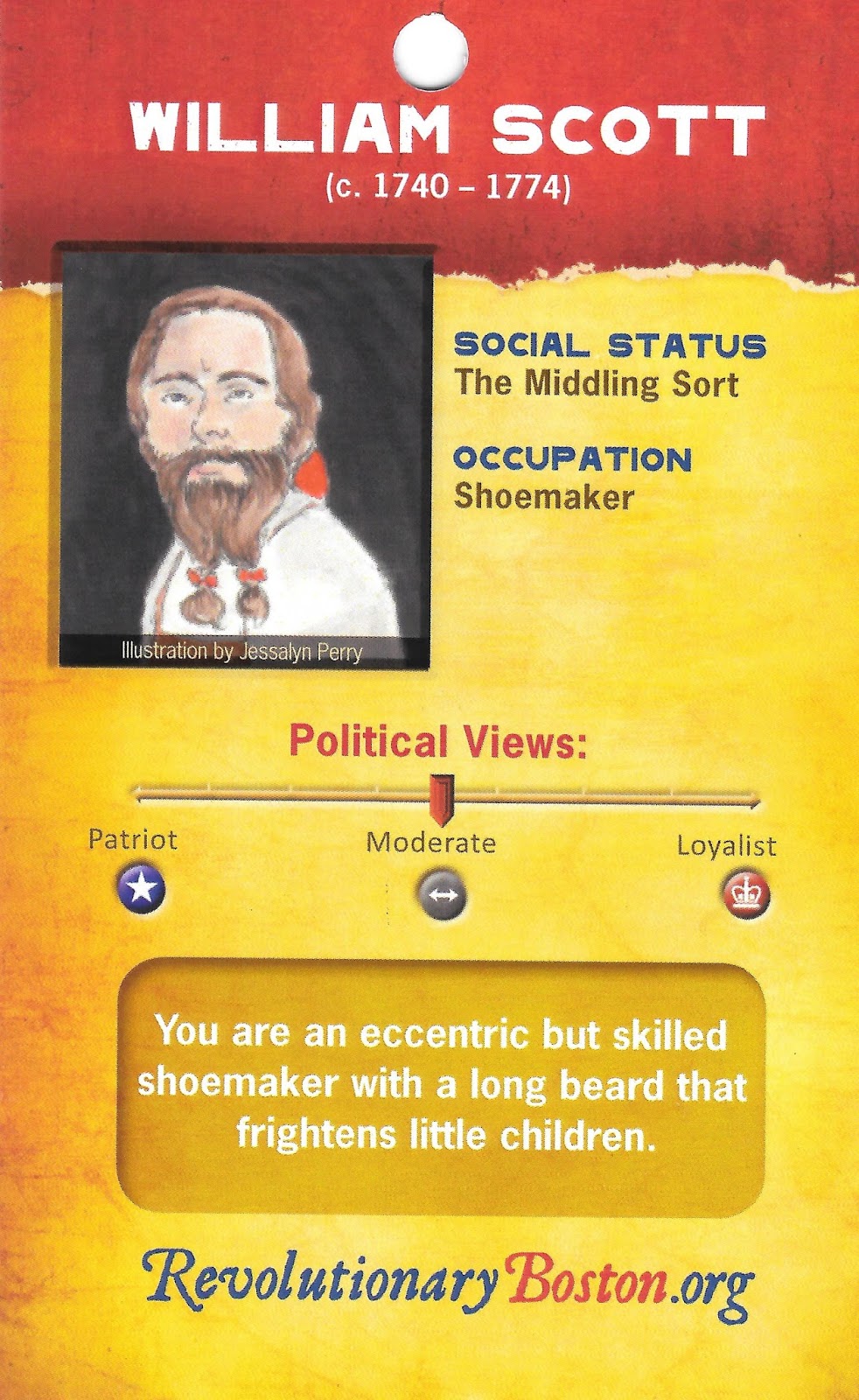
Each person received a card bearing the name of a person from the Revolutionary War period.  I was Francis Akeley, a self-employed wheelwright, but I didn't have to speak in the re-enactment. Jerry was William Scott, and he was a vocal participant in the re-enactment of the Dec. 16, 1773 town meeting.


~ Costumed interpreters.  ~


From the Meeting House we toured the Beaver ship, then we went through the museum and viewed artifacts including the tea chest known as "Robinson's Half Chest" - one of only two known tea chests that still exists from the 1773 Boston Tea Party, and one of Boston's oldest museum artifacts.

The tour concluded with a multi-sensory, action packed film in Minuteman Theater titled "Let it Begin Here."  The 15-minute film, shown on a giant wrap-around screen, recounted the first day of the American Revolution.

From the museum we made our way back to stop #1 where the trolley departed at 5:30 to take us back to our hotel.

Our first day touring Boston was interesting and enjoyable.  Coming up, day #2.


Tuesday, May 31, 2016

Day #1 in Boston, Massachusetts

After a brief break while preparing for two speaking engagements, as well as trying to figure out Windows 10, I'm back to share highlights from my recent trip to Boston and New York City. Microsoft switched my computer from Windows 7 to Windows 10 [without my knowledge or consent...grrr!] and it's been a challenge to figure out. 

This was my first visit Boston, and there were so many great, historic places to see.  We arrived on Monday afternoon, May 9th, but didn't begin sightseeing until the next day. Several weeks before our trip my hubby ordered two-day passes for each of us from Old Town Trolley Tours with 16 hop on hop off stops - the only way to see the best sites when unfamiliar with the city.  

After a great hotel breakfast, the trolley picked us up in front of our hotel at 7:15 a.m. to begin a fun day.  Embassy Suites [our home away from home for four days] is located in Boston's east end, near Logan airport. 


Trolley Driver performing for the camera while I watched from inside the trolley.   Trolley tours from stop #1 to stop #16 takes about 1 hour and 45 minutes.


We rode through the Ted Williams tunnel, named for famed Boston Red Sox baseball player. The trolley driver told us Ted Williams was the first one to drive through the tunnel on a golf cart when it opened.  A bronze plaque of Williams is affixed to the entrance of the tunnel, but I wasn't quick enough to get a photo.

The tunnel is part of a much larger project referred to as the "Big Dig" that rerouted Interstate 93 which previously ran above ground through the heart of downtown Boston, to the bottom of the harbor floor.   It is 9 miles long, took 17 years to build, and went way over budget.

A 45-minute sightseeing cruise of Boston Harbor was included in our Trolley package, and since the boat departed from Long Wharf at stop #1, we decided to go on the cruise first.


Below is the cruise boat docked at Long Wharf. Built in 1710 it's the oldest, continuing wharf in the United States.  In its heyday, Boston was the leading colonial port and Long Wharf was the nucleus of Boston's maritime trade. 50 vessels could dock there handling both costal and international trade.


Jerry giving our tickets to the gate employee before we boarded the boat.


Two historic buildings seen from the top deck of the cruise boat are [1] the Gardiner Building constructed in 1763 - smaller red brick building at left. It was once John Hancock's counting house, and serviced sailing ships. It is now a restaurant called Chart House, and is the wharf's oldest surviving structure. [2] The Custom House Block built in 1848 - large granite warehouse in the middle of photo.


Long Wharf and Custom House are National Historic Landmarks.  Custom House was once leased to the federal government for customs work, but the building has been converted to residential, commercial, and office space today.


Photo below taken while pulling out of the dock.  As you can see it was a picture perfect day. We were told the week before was rainy and cold, but the temperatures were great while we were there - not real hot, and warm enough to shed a lightweight jacket by mid-day. The imposing red brick building overlooking the dock is the Marriott Hotel.


The guide told us 75% of Boston sits on man-made land supported by rock retaining walls, as you can see in the photos above and below.


~ Boston as seen from the harbor ~


The Nantucket [below] is a floating lighthouse commissioned in 1952.  It's the youngest lightship to be built in the U.S. as well as the last one in service. It was decommissioned in 1984 for use as a floating museum in Boston Harbor, and has a National Treasure status.


Below is Charlestown Navy Yard and USS Constitution ["Old Ironsides"].  Charlestown Navy Yard was one of the first shipbuilding and repair facilities organized by the U.S. government. The USS Constitution [built in 1797] is its centerpiece.  It is currently being repaired so wasn't available for touring.  Also in Charlestown is the Bunker Hill Monument, which we hope to see up close on our next visit. 


~ Harbor condominiums ~


When our cruise was over we got back on the trolley and stayed on through all the stops until we reached #16 - which was the last stop at Boston Tea Party Ships and Museum. Along the route, we learned Boston has 34 harbor islands, the largest Chinatown in America, the oldest Botanical Gardens begun in 1859, over 100 colleges and universities with 300,000 students, the oldest YMCA, and the largest collection of Brownstone [sandstone] Townhouses.


It also has the oldest baseball park in America - Fenway Park, which hosted its first major league baseball game in April of 1912.  


The bronze statues are Red Sox players Ted Williams, Bobby Doerr and Johnny Pesky.  Dom DiMaggio got squeezed out in the photo below.


Boston also boasts the oldest free-lending library in America.  Boston Public Library was established in 1852.  Among its seven million books is the presidential library of John Adams, second President of the United States.


Stop #16 - The red wood building on Congress Street Bridge - Griffin's Wharf - is where the Boston Tea Party Ships and Museum is located.  It opened in June 2012.  


The "Beaver" [pictured below] sits on one side of the museum, and the "Eleanor" on the other side. 


Jerry hanging with Samuel Adams in front of the museum.


Abigail's Tea Room is a part of the museum and the employees [mostly college/university students] are dressed in period costume.  See tomorrow's post.


Jerry and me on board the Beaver [part of the museum tour].  We were taken below deck to see the Captain's Quarter's and where the crew slept.  We also had an opportunity to throw a chest of tea into the Harbor - not real tea - I would never waste real tea!